Standards and Interfaces
Standardized norms and interfaces are enormously important for the recording and exchange of data regarding planning, construction and operation of wastewater facilities and are a prerequisite for uniform documentation. The investigation results of a sewer inspection must describe the condition of a drainage system in a clear and content-comparable form. Our software supports all common defect catalogs and interfaces in the sewer industry.
Defect Catalogs
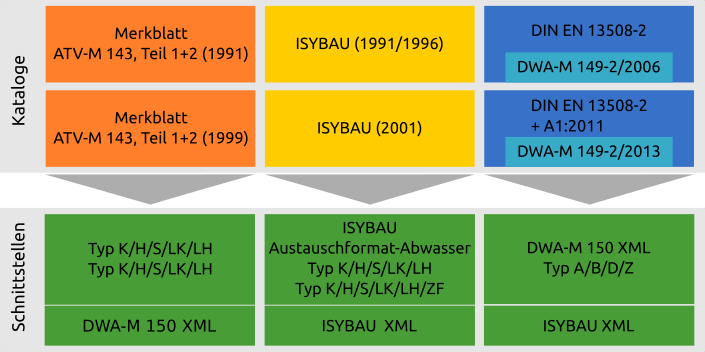
For the precise documentation of sewer conditions, a uniform description of defects and investigation results in the form of a coding system was developed in the early 1990s. The coding system describes the different types of defects using defined characters and thus enables an assessment of the entire object. Over the years, the coding system for the investigation of wastewater pipes and manholes has been expanded and various catalogs have been developed.
ATV
From 1991 onwards, the condition assessment of wastewater pipes and sewers was carried out using the coding system of the technical bulletin ATV-M 143-2 (“Optical Inspection – Inspection, Repair, Rehabilitation and Renewal of Wastewater Sewers and Pipes”). Until 1999, this bulletin was supplemented and updated several times. Through the merger of the German Association for Water, Wastewater and Waste (ATV) with the German Association for Water Resources and Land Improvement (DVWK) in 2000, the ATV catalogs were finally replaced by the technical bulletin DWA-M 149-2 in 2006 and have since been under the umbrella of the DWA.
- ATV-M 143 / Part 1+2 1991
- ATV-M 143 / Part 1+2 1999
ISYBAU
The ISYBAU “Wastewater Working Aids” provide comprehensive assistance in planning, construction and operation of wastewater facilities on federal properties. The ISYBAU catalogs were developed until 2001; later, the focus was exclusively on the development of exchange formats and interfaces.
- ISYBAU 1991
- ISYBAU 1996
- ISYBAU 2001
European Standard
With the publication and introduction of the European standard DIN EN 13508-2 (“Investigation and assessment of drain and sewer systems outside buildings – Part 2: Visual inspection coding system”) in May 2003, an alignment of all national regulations for optical inspection was achieved. The transition period for introduction ended in May 2006. Since then, new inspection programs must only be carried out in accordance with DIN EN 13508-2. Inspection programs that began before May 2006 can be completed using the original systems. The European standard DIN EN 13508-2 contains authoritative regulations for the optical internal inspection of wastewater facilities outside buildings.
- DIN EN 13508-2
European Standard Germany
The technical bulletin DWA-M 149-2/2006 is intended as an application guide and contains extensions and recommendations for applying DIN EN 13508-2 in the German-speaking region. It facilitates the user’s work and promotes a uniform inspection practice. The bulletin was published in 2006 and supplemented and superseded in 2011 by the European Committee for Standardization (CEN) with the worksheet A1:2011. The regulation DIN EN 13508-2:2003 + A1:2011 corresponds to DIN EN 13508-2:2011. The DWA in turn followed up in 2013 with the extended and adapted bulletin DWA-M 149-2/2013, which serves as the current supplement to the DIN regulation.
- DIN EN 13508-2:2003 + DWA-M 149-2/2006
- DIN EN 13508-2:2003 + A1:2011 + DWA-M 149-2/2013
European Standard Switzerland
In 2003, the Europe-wide binding regulation for optical inspection SN EN 13508-2 also came into force in Switzerland. The VSA Commission “Sewer Maintenance” additionally supplemented and specified the regulation in 2007 with further guidelines on defect description and Swiss conditions.
- SN EN 13508-2; VSA Guideline 2007
- SN EN 13508-2; VSA Guideline 2019
Haite Catalog
For many inspectors, the EU standard is unfamiliar. Specifying the correct code combination is, in contrast to the old standards, hardly intuitive anymore. Therefore, the software company Haite has created the so-called Haite Catalog. It is structured similarly to the old standards but internally generates EN 13508-2 codes automatically during input. An important advantage of the Haite Catalog is the accelerated input. The Haite Catalog combines multiple code combinations for defect descriptions, so that a single input by the inspector automatically generates multiple EN 13508-2 code combinations when needed. This way, no combination can be forgotten during input.
KG2000 Catalog Generator
If required, custom catalogs can also be created using the catalog generator KG2000.
Interfaces
The following interfaces are available for the import and export of sewer master data, inspection and geometry data:
- DWA-M 145-3
- DWA-M 150 XML Type A / B / D / Z*
- ISYBAU 2024 XML
- ISYBAU 2017 XML
- ISYBAU 2013 XML
- ISYBAU 2006 XML
- ISYBAU 2001 V0601 Type K / H / S / LK / LH / ZF**
- ISYBAU 1996 V0196 Type K / H / S / LK / LH**
- ISYBAU 1991 Type H / LH**
- Excel Export
- KANDIS 3.00 / 4.00
- BWB-Berlin V05
- K2000/Barthauer Interface
- K2000/DATAVER Interface (Switzerland)
- INTERLIS Interface (Switzerland)
The most commonly used interfaces are the ISYBAU XML and the DWA-M 150 interface. In addition, numerous special interfaces have been implemented for many cities and municipalities that enable seamless data transfer between K2000 programs and third-party systems (GIS systems).
The K2000/Barthauer interface, for example, enables seamless exchange of sewer data between the K2000 software programs and the BaSYS system by Barthauer. The same applies to the Swiss market. With the K2000/DATAVER interface and the INTERLIS interface, all Swiss guidelines and cantonal laws are supported, ensuring seamless exchange of inspection and geometry data.
Legend:
*A=Master data, B=Inspection data, D=Condition assessment, Z=Expandable with custom data fields **H=Section data, K=Master data, S=Manholes, LH=Pipe and house connection data, LK=Pipe master data, ZF=Condition videos, V=Geometry data